So I think I worked a lot of the anger out of my system with the anti-nazi video. The trouble is, with all the anger temporarily gone, it gave my brain the opportunity to start thinking. And the result of this explosion of thinking is the following video. Today's quiz question is: How much heavily caffienated beverage did I imbibe before doing this?
The answer to the quiz question is: far too much. The URL for the video is:
http://www.youtube.com/watch?v=yeX3_-VvpE8
Saturday, August 05, 2006


Friday, August 04, 2006
YouTube is overrun by Nazis
According to Godwin's law if you call someone a Nazi in an argument, you've already lost the argument (actually, this isn't accurate - check here for the history of Godwin's law.) It all becomes a moot point when you're dealing with actual Nazis.
I joined in the YouTube anti-racism campaign without realising exactly how bad that Nazi infestation was. Since posting some anti-racism videos I've had a first hand introduction to the pathetic fools populating that place who think they're the master race. Some hide behind the euphemism "white nationalist" (not that I think that's much of a euphemism) but a lot of them are literally flag waving Nazis.
This is absolutely pathetic and it's been making me progressively more angry. The anger burst forth into the following video - probably the angriest one I've made for a while. The funny thing is I forget to switch the proper light on so it ended up too dark. I cheated a bit with my video editing software to boost the light so you could see me and I actually quite like the gothic look I ended up with. I think the time has come to play with my video effects more.
As always, spread the message far and wide, however you choose. The URL for this video is:
http://www.youtube.com/watch?v=H-l29Kd0W6M
I joined in the YouTube anti-racism campaign without realising exactly how bad that Nazi infestation was. Since posting some anti-racism videos I've had a first hand introduction to the pathetic fools populating that place who think they're the master race. Some hide behind the euphemism "white nationalist" (not that I think that's much of a euphemism) but a lot of them are literally flag waving Nazis.
This is absolutely pathetic and it's been making me progressively more angry. The anger burst forth into the following video - probably the angriest one I've made for a while. The funny thing is I forget to switch the proper light on so it ended up too dark. I cheated a bit with my video editing software to boost the light so you could see me and I actually quite like the gothic look I ended up with. I think the time has come to play with my video effects more.
As always, spread the message far and wide, however you choose. The URL for this video is:
http://www.youtube.com/watch?v=H-l29Kd0W6M
Mr Angry's rules for recruitment agencies dealing with contractors
This final post in my series on contracting covers the often fraught but usually necessary relationship between contractors and recruitment agencies. I know it is possible to gain employment without dealing with employment agencies. In some cities the bias is stronger one way or the other. In my market it is theoretically possible to work as a contractor without going through intermediaries but in practice this is extremely hard to achieve and you would be cutting yourself out of 90+% of contract opportunities.
So let's be honest: as a contractor you're looking to get the maximum dollars for each job. We are the prostitutes of the workplace. And any hooker who wants to enjoy life has to choose their pimp carefully. You want one of the better pimps like Heidi Fleiss who will at least try to get you good surroundings, good pay and a higher class of... client. Avoid the ones who treat you like a low-class street worker and who seem to enjoy smacking you upside the head with regular frequency.
Jokes aside, the relationship between a contractor and an agency is important. It's how you find work and it's how you get paid. The suggestions in this post are aimed at recruitment agencies but of course my advice to contractors is seek out agencies who match the positive traits below and avoid the negative ones. I'll probably be treading a little lightly for two reasons. First, simply out of respect for all the agencies I've dealt with who do good work - this isn't a mindless complaining session. The relationship between a contractor and agency is a professional one and that requires professionalism from both sides to work effectively. Second, I may have mentioned before that the IT job market I find myself in is comparatively small, conservative and gossipy. I don't want the bad agencies all fired up to work out who I really am so they can blacklist me.
The number one recommendation I feel compelled to offer agencies is don't play games with contractors. The favourite game of agencies is undoubtedly "guess the pay rate you can get away with on this job." I have lost count of the number of times agencies have asked me "what rate are you looking for?" This question is absolutely pointless as the answer is always "the maximum I can possibly get away with." Money is not my only motivator but I if someone is asking me how much I want to be paid, the answer is the highest rate on offer.
Be open and honest with contractors. Come straight out and say "based on your experience and what this client has indicated they are willing to pay I think you should ask for $xxx." Let contractors know when they are asking for an unrealistically high amount (either because of their experience, equally qualified applicants willing to accept less, the job market generally or a particularly client being a tight-arse) but don't try to trick them into accepting less that they might have been able to get.
And speaking of being open and honest, always tell contractors what your cut of the deal is. Don't wait for them to ask (and definitely don't refuse to tell if they ask). The contractor deserves to know how much you are making out of their placement. The only possible reason I can think of for not telling a contractor this information is that you are screwing them and taking too big of a cut. Trust me, if this isn't your reason, contractors think that it's your reason.
Another thing to never do with contractors is to suggest that they should sign an exclusive deal with you unless they are on your permanent payroll (and then they cease to be contractors, don't they?) The very definition of contractors is that they are free agents; if you want them on your books, get them a contract. I have had this suggested to me many times over the years and always politely declined. The people responsible should be embarrassed for asking. The most egregious example I can remember was from an agency where I couldn't hear a single local accent, everyone who worked there seemed to be a tourist with a temporary work visa. Who exactly was I pledging my loyalty to when none of them were going to be in the country six months later?
And don't say that it looks "unprofessional" if a contractor has their resume with too many agencies. This is a complete lie. I don't care if you've convinced yourself it's true, my years of experience have proven to me that it isn't true. Over the years I've applied for jobs with dozens of agencies and I frequently have my resume with more than half a dozen at the same time and I have never suffered adversely. Employers simply don't know and agencies don't tell each other who's on their books - agencies trust each other less than contractors trust agencies.
Another important rule is when dealing with a specialised area like IT, try to have some understanding of the requirements for each role. It is blindingly obvious when an agency is completely ignorant about a role because they'll ask for something that's impossible. The usual is to ask for an absurd number of years' experience with a new technology. In the current market, this would be something like asking for 5 years' experience with AJAX or some other Web 2.0 technology. My favourite personal experience was from way back when everybody was working on Y2K projects and I was asked if I had previous Y2K experience. What, you mean from the last time it was the year 2000?
Smaller agencies tend to have people with a better understanding of the technical aspects of IT work as they often seem to be run by former contractors who figured that recruiting was where the real money was. But it really is unforgivable for any agency to be completely ignorant about the requirements for a role when they are recruiting. These agencies deserve the scorn they get from contractors.
And speaking of understanding the requirements, don't lie about your candidate's experience and/or skill in the hope of suckering an employer. And if you do this, have the common decency to tell the contractor you've done it. I have heard many times from employers railing against IT workers (particularly programmers it seems) lying on their resumes but I have personally experienced a situation where an agency lied "on my behalf" without telling me. Words don't quite capture the feeling of terror I experienced during an interview as I was reading the copy of my resume the interviewer was holding and saw it contained lies I hadn't put there. Thankfully I had rehearsed for all my own lies but I didn't know if I could convincingly fake a response to something I had no preparation for.
I have often thought the most difficult part of recruiting contractors for IT must be that you spend the whole day dealing with people who make significantly more money than you. In many cases astronomically more. I know front line staff in recruiting agencies do not tend to be fabulously well paid but to be brutally honest, this isn't the contractor's fault. If you can't deal with seeing people who already make way more money than you asking for more, you need to find another line of work.
To summarise, in order for the relationship between a contractor and an agency to work, it has to be based on openness and honestly. Many contractors, myself included, will suffer through a bad relationship with an agency for a limited time if suitably rewarded. But if your starting point is to exploit contractors as much as possible rather than to help them as much as possible, it's going to catch up with you. What goes around comes around.
So let's be honest: as a contractor you're looking to get the maximum dollars for each job. We are the prostitutes of the workplace. And any hooker who wants to enjoy life has to choose their pimp carefully. You want one of the better pimps like Heidi Fleiss who will at least try to get you good surroundings, good pay and a higher class of... client. Avoid the ones who treat you like a low-class street worker and who seem to enjoy smacking you upside the head with regular frequency.
Jokes aside, the relationship between a contractor and an agency is important. It's how you find work and it's how you get paid. The suggestions in this post are aimed at recruitment agencies but of course my advice to contractors is seek out agencies who match the positive traits below and avoid the negative ones. I'll probably be treading a little lightly for two reasons. First, simply out of respect for all the agencies I've dealt with who do good work - this isn't a mindless complaining session. The relationship between a contractor and agency is a professional one and that requires professionalism from both sides to work effectively. Second, I may have mentioned before that the IT job market I find myself in is comparatively small, conservative and gossipy. I don't want the bad agencies all fired up to work out who I really am so they can blacklist me.
The number one recommendation I feel compelled to offer agencies is don't play games with contractors. The favourite game of agencies is undoubtedly "guess the pay rate you can get away with on this job." I have lost count of the number of times agencies have asked me "what rate are you looking for?" This question is absolutely pointless as the answer is always "the maximum I can possibly get away with." Money is not my only motivator but I if someone is asking me how much I want to be paid, the answer is the highest rate on offer.
Be open and honest with contractors. Come straight out and say "based on your experience and what this client has indicated they are willing to pay I think you should ask for $xxx." Let contractors know when they are asking for an unrealistically high amount (either because of their experience, equally qualified applicants willing to accept less, the job market generally or a particularly client being a tight-arse) but don't try to trick them into accepting less that they might have been able to get.
And speaking of being open and honest, always tell contractors what your cut of the deal is. Don't wait for them to ask (and definitely don't refuse to tell if they ask). The contractor deserves to know how much you are making out of their placement. The only possible reason I can think of for not telling a contractor this information is that you are screwing them and taking too big of a cut. Trust me, if this isn't your reason, contractors think that it's your reason.
Another thing to never do with contractors is to suggest that they should sign an exclusive deal with you unless they are on your permanent payroll (and then they cease to be contractors, don't they?) The very definition of contractors is that they are free agents; if you want them on your books, get them a contract. I have had this suggested to me many times over the years and always politely declined. The people responsible should be embarrassed for asking. The most egregious example I can remember was from an agency where I couldn't hear a single local accent, everyone who worked there seemed to be a tourist with a temporary work visa. Who exactly was I pledging my loyalty to when none of them were going to be in the country six months later?
And don't say that it looks "unprofessional" if a contractor has their resume with too many agencies. This is a complete lie. I don't care if you've convinced yourself it's true, my years of experience have proven to me that it isn't true. Over the years I've applied for jobs with dozens of agencies and I frequently have my resume with more than half a dozen at the same time and I have never suffered adversely. Employers simply don't know and agencies don't tell each other who's on their books - agencies trust each other less than contractors trust agencies.
Another important rule is when dealing with a specialised area like IT, try to have some understanding of the requirements for each role. It is blindingly obvious when an agency is completely ignorant about a role because they'll ask for something that's impossible. The usual is to ask for an absurd number of years' experience with a new technology. In the current market, this would be something like asking for 5 years' experience with AJAX or some other Web 2.0 technology. My favourite personal experience was from way back when everybody was working on Y2K projects and I was asked if I had previous Y2K experience. What, you mean from the last time it was the year 2000?
Smaller agencies tend to have people with a better understanding of the technical aspects of IT work as they often seem to be run by former contractors who figured that recruiting was where the real money was. But it really is unforgivable for any agency to be completely ignorant about the requirements for a role when they are recruiting. These agencies deserve the scorn they get from contractors.
And speaking of understanding the requirements, don't lie about your candidate's experience and/or skill in the hope of suckering an employer. And if you do this, have the common decency to tell the contractor you've done it. I have heard many times from employers railing against IT workers (particularly programmers it seems) lying on their resumes but I have personally experienced a situation where an agency lied "on my behalf" without telling me. Words don't quite capture the feeling of terror I experienced during an interview as I was reading the copy of my resume the interviewer was holding and saw it contained lies I hadn't put there. Thankfully I had rehearsed for all my own lies but I didn't know if I could convincingly fake a response to something I had no preparation for.
I have often thought the most difficult part of recruiting contractors for IT must be that you spend the whole day dealing with people who make significantly more money than you. In many cases astronomically more. I know front line staff in recruiting agencies do not tend to be fabulously well paid but to be brutally honest, this isn't the contractor's fault. If you can't deal with seeing people who already make way more money than you asking for more, you need to find another line of work.
To summarise, in order for the relationship between a contractor and an agency to work, it has to be based on openness and honestly. Many contractors, myself included, will suffer through a bad relationship with an agency for a limited time if suitably rewarded. But if your starting point is to exploit contractors as much as possible rather than to help them as much as possible, it's going to catch up with you. What goes around comes around.
Thursday, August 03, 2006
Mr Angry - Unsafe for children
Some video news in this post. The first item is now that I've posted more than 30 videos on YouTube I've realised that it might not be such a good idea to have all my eggs in one video-hosting basket. I'm going to keep posting videos via YouTube because it has the biggest user base by far so there's a better chance of spreading the angry meme that way. But last night I started looking for a backup and decided to look into Revver as lots of people are talking about it.
The first thing I noticed about Revver was that they integrate advertising into videos you post giving the opportunity to be paid for making videos. So far as I can tell, a single ad is pasted onto the end of your video and if someone clicks on it you get paid. A possible "shock, horror" moment for anti-advertising purists, but an interesting idea. They extend this quite well because wherever the video is embedded using their code (e.g. this blog) the ad is included, so no matter who posts the video in whatever form (including as an email attachment) the ad is included and could generate revenue.
From my first glance, there are a few shortcomings with Revver. Obviously, the incorporation of advertising directly into my videos is a debasement and prostitution of my pure art. In other words, I like the idea (how many times do I have to say I'm a whore?) The site seems harder to use and navigate generally than YouTube but maybe it just takes getting used to. I haven't seen yet how you build "community" the way YouTube promotes - getting people to subscribe to your videos and suchlike. This being my number one reason for posting videos, it's something I need to work out and I think Revver should make this aspect easier and/or more obvious.
Also, YouTube posts your videos as Flash files (pretty much universal) and Revver posts them as QuickTime files (not nearly as universal). For instance, I can't watch Revver videos at work (in my lunch hour - heaven forbid I'd skive off work) because they don't include QuickTime on the PCs and I'm not allowed to install any applications. I don't know if there was any deal with Apple that led them to use QuickTime but I'd have to say the decision was a mistake - anything that limits your market penetration is a bad idea.
I don't even know if I can embed Revver videos into Wordpress yet, that's something I will have to experiment with. Obviously, that would be deal-breaker. But even if I was able to post them and some people had trouble viewing them - that would be a deal-breaker. The one thing I have always tried to do with my blog is limit the barriers to readers and commenters. I recently had to do the text "captcha" thingie on Blogger because I was being barraged with about 50 spams at a time by the same wanker. I'm going to experiment with taking that off again and see if the same problem recurs. I haven't had to do that with WordPress because of the 99.9% effectiveness of Akismet anti-spam. But there's no way I would want to force users to download specific software to watch my videos (apart from Flash - seriously, if you don't have that installed get your shit together already).
Another interesting thing I noticed about Revver is they have an "age appropriate" rating system. When you post a video they ask you to rate it voluntarily. You get to choose from G, PG13, PG13 (parents strongly cautioned), R (recommended for adults) and R (definitely not for anyone under 17). I decided to go for PG13 (parents strongly cautioned). The interesting thing is, the rating was changed to R before the video was posted. This required manual intervention from somebody at Revver. I actually agree with their revised rating but their method of manually reviewing ratings won't scale well if they end up with a lot of videos being posted like YouTube.
YouTube relies on users flagging content as inappropriate, something that seems to work very quickly. Any stories you hear about YouTube being flooded with porn are grossly exaggerated. If you think you can find any porn on YouTube, send me the URL. Purely in the interests of investigative blogging. What I suspect with Revver is either the volume of contributions are so low they can afford to check all of them at the moment or they only check ones that have been voluntarily given a higher than G rating (or even higher than PG). Either way, if their popularity increases they won't be able to keep it up.
I'm going to test this theory by posting something G rated and see if it stays rated G (maybe my user name is flagged R now). If it stays G then I'm going to post one of my potty mouthed rants with a G rating and see what happens. Hmmm, it will probably get me banned from Revver.
One interesting facet of the "making money" element of Revver is that it's making some users get pissed off at YouTube. The talented ZeFrank is one person who makes money from Revver and tells people not to post his videos to YouTube. I can see the short term reasoning behind this - "I'm making money from Revver and not from YouTube. YouTube is potentially making money from me and I don't see a cent of it, plus, it's potentially stealing viewers from Revver and therefore depriving me of ad revenue."
I think this approach is short-sighted. Ultimately, the more people that see your work, the better. You might miss out on some money short term but, assuming your work is of sufficient quality and you're not a one trick pony, you'll make more money longer term from a bigger audience overall. A lot of the users of these online tools (video sharing, blogging, Digg etc.) are grossly exaggerating their importance. The best that 99.9999% of users can hope for is that they are a stepping stone to something bigger - they aren't the end point of any quest for fame and fortune.
YouTube is far and away the dominant video sharing site and in terms of real population (YouTube has potential world-wide reach after all) practically nobody watches it. They can hype their 100 million views a day as much as they like (personally I suspect that figure is greatly inflated) but compared to TV and cinemas they're doing diddly-squat on the world stage. The most viewed video of all time on YouTube has apparently been watched more than 30 million times which is pretty damn good and they list around 100 videos as being watched more than 1.5 million times.
My quick and unscientific analysis of their top videos is that less than 10% of them are original works - they're mostly lip-synching and clips from TV shows and movies. This doesn't mean that they're not creative but they're not original material which means that the people who made them would have a hard time parlaying this into a commercial return. Essentially, if you seek to make money by using someone else's copyrighted material then you're asking for trouble. Besides which, as much as I would love my videos to be watched more than a million times, it's a pretty inconsequential number.
Any TV show that had a total of a few million viewers world-wide would be cancelled in an eye blink. Any song that was heard a million times IN TOTAL around the world would be a dismal commercial failure. And Tom Cruise would flat out kill himself if only a few million people had ever seen him in a movie. We can always hope.
What was my point again? Oh yeah, limiting where your videos can be shown. In the world of microcelebrity, attention is the currency. Actual money is slowly becoming the currency for a few people but mostly it's attention that matters. ZeFrank puts his videos on Revver and his owns site and tries to stop them being put on YouTube or other places because (presumably) he thinks it limits his financial returns. I think he's wrong - the more people who see/hear/read your works, the more chance you have of developing a long term career.
We'll see if I maintain this open-minded attitude if I ever start making some actual money. I reserve the right to be a total hypocrite on this topic. Much as I reserve that right for any topic. In fact never trust anything I say. Especially when I tell you not to trust me.
The first thing I noticed about Revver was that they integrate advertising into videos you post giving the opportunity to be paid for making videos. So far as I can tell, a single ad is pasted onto the end of your video and if someone clicks on it you get paid. A possible "shock, horror" moment for anti-advertising purists, but an interesting idea. They extend this quite well because wherever the video is embedded using their code (e.g. this blog) the ad is included, so no matter who posts the video in whatever form (including as an email attachment) the ad is included and could generate revenue.
From my first glance, there are a few shortcomings with Revver. Obviously, the incorporation of advertising directly into my videos is a debasement and prostitution of my pure art. In other words, I like the idea (how many times do I have to say I'm a whore?) The site seems harder to use and navigate generally than YouTube but maybe it just takes getting used to. I haven't seen yet how you build "community" the way YouTube promotes - getting people to subscribe to your videos and suchlike. This being my number one reason for posting videos, it's something I need to work out and I think Revver should make this aspect easier and/or more obvious.
Also, YouTube posts your videos as Flash files (pretty much universal) and Revver posts them as QuickTime files (not nearly as universal). For instance, I can't watch Revver videos at work (in my lunch hour - heaven forbid I'd skive off work) because they don't include QuickTime on the PCs and I'm not allowed to install any applications. I don't know if there was any deal with Apple that led them to use QuickTime but I'd have to say the decision was a mistake - anything that limits your market penetration is a bad idea.
I don't even know if I can embed Revver videos into Wordpress yet, that's something I will have to experiment with. Obviously, that would be deal-breaker. But even if I was able to post them and some people had trouble viewing them - that would be a deal-breaker. The one thing I have always tried to do with my blog is limit the barriers to readers and commenters. I recently had to do the text "captcha" thingie on Blogger because I was being barraged with about 50 spams at a time by the same wanker. I'm going to experiment with taking that off again and see if the same problem recurs. I haven't had to do that with WordPress because of the 99.9% effectiveness of Akismet anti-spam. But there's no way I would want to force users to download specific software to watch my videos (apart from Flash - seriously, if you don't have that installed get your shit together already).
Another interesting thing I noticed about Revver is they have an "age appropriate" rating system. When you post a video they ask you to rate it voluntarily. You get to choose from G, PG13, PG13 (parents strongly cautioned), R (recommended for adults) and R (definitely not for anyone under 17). I decided to go for PG13 (parents strongly cautioned). The interesting thing is, the rating was changed to R before the video was posted. This required manual intervention from somebody at Revver. I actually agree with their revised rating but their method of manually reviewing ratings won't scale well if they end up with a lot of videos being posted like YouTube.
YouTube relies on users flagging content as inappropriate, something that seems to work very quickly. Any stories you hear about YouTube being flooded with porn are grossly exaggerated. If you think you can find any porn on YouTube, send me the URL. Purely in the interests of investigative blogging. What I suspect with Revver is either the volume of contributions are so low they can afford to check all of them at the moment or they only check ones that have been voluntarily given a higher than G rating (or even higher than PG). Either way, if their popularity increases they won't be able to keep it up.
I'm going to test this theory by posting something G rated and see if it stays rated G (maybe my user name is flagged R now). If it stays G then I'm going to post one of my potty mouthed rants with a G rating and see what happens. Hmmm, it will probably get me banned from Revver.
One interesting facet of the "making money" element of Revver is that it's making some users get pissed off at YouTube. The talented ZeFrank is one person who makes money from Revver and tells people not to post his videos to YouTube. I can see the short term reasoning behind this - "I'm making money from Revver and not from YouTube. YouTube is potentially making money from me and I don't see a cent of it, plus, it's potentially stealing viewers from Revver and therefore depriving me of ad revenue."
I think this approach is short-sighted. Ultimately, the more people that see your work, the better. You might miss out on some money short term but, assuming your work is of sufficient quality and you're not a one trick pony, you'll make more money longer term from a bigger audience overall. A lot of the users of these online tools (video sharing, blogging, Digg etc.) are grossly exaggerating their importance. The best that 99.9999% of users can hope for is that they are a stepping stone to something bigger - they aren't the end point of any quest for fame and fortune.
YouTube is far and away the dominant video sharing site and in terms of real population (YouTube has potential world-wide reach after all) practically nobody watches it. They can hype their 100 million views a day as much as they like (personally I suspect that figure is greatly inflated) but compared to TV and cinemas they're doing diddly-squat on the world stage. The most viewed video of all time on YouTube has apparently been watched more than 30 million times which is pretty damn good and they list around 100 videos as being watched more than 1.5 million times.
My quick and unscientific analysis of their top videos is that less than 10% of them are original works - they're mostly lip-synching and clips from TV shows and movies. This doesn't mean that they're not creative but they're not original material which means that the people who made them would have a hard time parlaying this into a commercial return. Essentially, if you seek to make money by using someone else's copyrighted material then you're asking for trouble. Besides which, as much as I would love my videos to be watched more than a million times, it's a pretty inconsequential number.
Any TV show that had a total of a few million viewers world-wide would be cancelled in an eye blink. Any song that was heard a million times IN TOTAL around the world would be a dismal commercial failure. And Tom Cruise would flat out kill himself if only a few million people had ever seen him in a movie. We can always hope.
What was my point again? Oh yeah, limiting where your videos can be shown. In the world of microcelebrity, attention is the currency. Actual money is slowly becoming the currency for a few people but mostly it's attention that matters. ZeFrank puts his videos on Revver and his owns site and tries to stop them being put on YouTube or other places because (presumably) he thinks it limits his financial returns. I think he's wrong - the more people who see/hear/read your works, the more chance you have of developing a long term career.
We'll see if I maintain this open-minded attitude if I ever start making some actual money. I reserve the right to be a total hypocrite on this topic. Much as I reserve that right for any topic. In fact never trust anything I say. Especially when I tell you not to trust me.
Wednesday, August 02, 2006
Best ever song lyrics
I found myself thinking about my all-time favourite song lyrics today. This may sound a little off-topic for me but it started because I was thinking of theme music to use for videos. These lyrics aren't necessarily from my favourite artists (my number on favourite lyric comes from a song and artists I don't like at all) and even the ones that are by my favourite artists don't come from my favourite songs.
My number one all time favourite lyric is (drum roll please):
Lucky that my breasts are small and humble / so you don't mistake them for mountains - from "Whenever, wherever" by Shakira. I have no idea if this line is intentionally funny (I understand English is not her first language) but I find it absolutely hysterical. That's how juvenile I am.
My favourite angry lyrics are:
Say what you mean and say it mean - from "Ramrod" by Scraping Foetus Off The Wheel. This stands a good chance of being Mr Angry's theme song.
This is gonna hurt you / more than it's gonna hurt me / and I wouldn't have it any other way - from "Take Your Punishment (Motherfucker)" by Crent
Wake up / this country needs a fucking shake up / wake up / these cunts need a shake up - from "77%" by The Herd
You never had it so good / the favourite phrase of those who always had it better - from "Bring it Down" by The Redskins
I wonder if he even kissed me goodbye? / no I don't / I just wish he fucking died - from "Cleaning Out My Closet" by Eminem
Don't know what I want / but I know how to get it - from "Anarchy in the UK" by the Sex Pistols
Gotcha / you Argie bastard / gotcha / you fucking spik / gotcha / you latin bender / gotcha / you dago prick - from "Gotcha" by Crass (the lyrics were an ironic response to a headline in the conservative Sun newspaper during the Falklands War for anyone who's worried)
And some random favourites, mostly because of their poetry:
The white moon comes out / like a hole in the sky / the mangrove goes quiet - from "Bye Bye Pride" by The Go-Betweens (lyrics courtesy of the late, lamented G W McClennan)
I gave you a necklace of purple and blue / you took it so gently I felt see-though - from "Lock It" by The Falling Joys
I never made the 1st team / I just made the 1st team laugh - from "The Saturday Boy" by Billy Bragg (very hard to pick just one Billy Bragg lyric - I could have easily compiled a list of my 20 favourite Billy Bragg lyrics)
Big black Nemesis / parthenogenesis / everybody happy as the dead come home - from "Nemesis" by Shriekback (featured simply because they were able to work "parthenogenesis" into a song)
Last night I dreamt that somebody loved me / no hope, no harm / just another false alarm - from "Last Night I Dreamt That Somebody Loved Me" by The Smiths
You never do what you know you oughta / something tells me you're the devil's daughter - from "Sorrow" by David Bowie
What a scummy man / just give him half a chance / I bet he'll rob you if he can - from "When The Sun Goes Down" by The Arctic Monkeys
He thinks of himself as a victim of love / but he's a volunteer - from "Victim/Volunteer" by Christine Lavin
In a way I yearning to be done with all this measuring of truth / an eye for an eye and a tooth for a tooth / and anyway I told the truth and I am not afraid to die - from "The Mercy Seat" by Nick Cave and the Bad Seeds
I never dreamed that I would get to be / the kind of creature I always meant to be - from "Being Boring by The Pet Shop Boys
You said I wasn't cheap / you paid me twenty pounds - from "You're Gorgeous" by Babybird
I sucked a lot of cock to get where I am today - from "I Sucked a Lot Of Cock To Get Where I Am Today" by Regurgitator
The banks put out bright posters / saying we've got money to give away / and it's as easy as that right here / but the bank man is a bastard - from "The Marriage Is A Mess" by Not Drowning, Waving
These are lyrics that "speak" to me somehow - sometimes they're funny, sometimes they're poetic and sometimes they're suitable angry. I'd like to know your favourites too, I'm sure others can come up with a better list than this.
My number one all time favourite lyric is (drum roll please):
Lucky that my breasts are small and humble / so you don't mistake them for mountains - from "Whenever, wherever" by Shakira. I have no idea if this line is intentionally funny (I understand English is not her first language) but I find it absolutely hysterical. That's how juvenile I am.
My favourite angry lyrics are:
Say what you mean and say it mean - from "Ramrod" by Scraping Foetus Off The Wheel. This stands a good chance of being Mr Angry's theme song.
This is gonna hurt you / more than it's gonna hurt me / and I wouldn't have it any other way - from "Take Your Punishment (Motherfucker)" by Crent
Wake up / this country needs a fucking shake up / wake up / these cunts need a shake up - from "77%" by The Herd
You never had it so good / the favourite phrase of those who always had it better - from "Bring it Down" by The Redskins
I wonder if he even kissed me goodbye? / no I don't / I just wish he fucking died - from "Cleaning Out My Closet" by Eminem
Don't know what I want / but I know how to get it - from "Anarchy in the UK" by the Sex Pistols
Gotcha / you Argie bastard / gotcha / you fucking spik / gotcha / you latin bender / gotcha / you dago prick - from "Gotcha" by Crass (the lyrics were an ironic response to a headline in the conservative Sun newspaper during the Falklands War for anyone who's worried)
And some random favourites, mostly because of their poetry:
The white moon comes out / like a hole in the sky / the mangrove goes quiet - from "Bye Bye Pride" by The Go-Betweens (lyrics courtesy of the late, lamented G W McClennan)
I gave you a necklace of purple and blue / you took it so gently I felt see-though - from "Lock It" by The Falling Joys
I never made the 1st team / I just made the 1st team laugh - from "The Saturday Boy" by Billy Bragg (very hard to pick just one Billy Bragg lyric - I could have easily compiled a list of my 20 favourite Billy Bragg lyrics)
Big black Nemesis / parthenogenesis / everybody happy as the dead come home - from "Nemesis" by Shriekback (featured simply because they were able to work "parthenogenesis" into a song)
Last night I dreamt that somebody loved me / no hope, no harm / just another false alarm - from "Last Night I Dreamt That Somebody Loved Me" by The Smiths
You never do what you know you oughta / something tells me you're the devil's daughter - from "Sorrow" by David Bowie
What a scummy man / just give him half a chance / I bet he'll rob you if he can - from "When The Sun Goes Down" by The Arctic Monkeys
He thinks of himself as a victim of love / but he's a volunteer - from "Victim/Volunteer" by Christine Lavin
In a way I yearning to be done with all this measuring of truth / an eye for an eye and a tooth for a tooth / and anyway I told the truth and I am not afraid to die - from "The Mercy Seat" by Nick Cave and the Bad Seeds
I never dreamed that I would get to be / the kind of creature I always meant to be - from "Being Boring by The Pet Shop Boys
You said I wasn't cheap / you paid me twenty pounds - from "You're Gorgeous" by Babybird
I sucked a lot of cock to get where I am today - from "I Sucked a Lot Of Cock To Get Where I Am Today" by Regurgitator
The banks put out bright posters / saying we've got money to give away / and it's as easy as that right here / but the bank man is a bastard - from "The Marriage Is A Mess" by Not Drowning, Waving
These are lyrics that "speak" to me somehow - sometimes they're funny, sometimes they're poetic and sometimes they're suitable angry. I'd like to know your favourites too, I'm sure others can come up with a better list than this.
Tuesday, August 01, 2006
In the neck from Mr Angry and the Bastard Clan
Has there ever been a better expletive than "fuck you in the neck with a..."? If there is, I haven't heard it. I first saw "fuck you in the neck with a butter knife" on Happychick's blog and instantly knew I must make it mine and used it often. Then I was introduced to Sandra (Momma Bastard) and the Bastard Clan who were the source of this very wise saying.
I soon learned the diversity that could be applied to the saying, from the graphic (fuck you in the neck with a chainsaw) to the abstract (fuck you in the neck with your own shitty attitude). This is indeed a saying for all seasons, so it simply had to have its own t-shirt. This video is my tribute to "fuck you in the neck" and starts with the "making of" (see, you don't even have to wait for my DVD to come out to get the behind the scenes stuff). I had to think for a while about the background music for this one. I'm keen to promote independent Australian music and I though the choice of the tune "You shit me to tears" by The Tenants was an appropriate choice.
I'm going to have to start doing the stand-up performances I was always intending to do, if for no other reason than to wear this shirt in public. I wouldn't be game to wear it walking down the street. And let me know if there are any quotes from my previous posts that you think deserve to be immortalised on a t-shirt. I'm already looking into Range's suggestion to feature some sort of Mr Angry image.
The URL for the video for anyone who wishes to propagate it in whatever form is:
http://www.youtube.com/watch?v=fx21Xo6JGX8
I soon learned the diversity that could be applied to the saying, from the graphic (fuck you in the neck with a chainsaw) to the abstract (fuck you in the neck with your own shitty attitude). This is indeed a saying for all seasons, so it simply had to have its own t-shirt. This video is my tribute to "fuck you in the neck" and starts with the "making of" (see, you don't even have to wait for my DVD to come out to get the behind the scenes stuff). I had to think for a while about the background music for this one. I'm keen to promote independent Australian music and I though the choice of the tune "You shit me to tears" by The Tenants was an appropriate choice.
I'm going to have to start doing the stand-up performances I was always intending to do, if for no other reason than to wear this shirt in public. I wouldn't be game to wear it walking down the street. And let me know if there are any quotes from my previous posts that you think deserve to be immortalised on a t-shirt. I'm already looking into Range's suggestion to feature some sort of Mr Angry image.
The URL for the video for anyone who wishes to propagate it in whatever form is:
http://www.youtube.com/watch?v=fx21Xo6JGX8
Monday, July 31, 2006
Mr Angry's rules for permanent employees working with contractors
This post in my series on contracting focuses on suggestions for non-management permanent employees working with contractors. The driver for this is that over the years I've worked on both sides of the fence and I've seen the sorts of preconceptions and misconceptions that can strain working relationships between permanent and contract staff. The sources for the suggestions in this post are a combination of things I have seen myself and the questions I am most commonly asked about contracting by permanent staff.
Let's get the touchy one out of the way first: money. Don't ask a contractor how much they are getting. Ever. It's unprofessional and rude and, honestly, no good is going to come out of asking. If you want an idea of how much contractors can earn, look up some job ads. I've covered this topic in detail in previous posts so, if you need to, go back and re-read the sections comparing contract rates to permanent rates.
Contractors are not, by definition, any better than permanent employees at what they do. The reason for employing a contractor can vary from case to case and it's worth finding out the reason a contractor has been hired if you find yourself working with one. If there's any sort of decent management in your workplace (a big "if", I know) then the contractor will have skills and/or experience that nobody else has. In the case of specialists, it's easy to see why a contractor has been brought on but this is not always the case. Sometimes a contractor will have the same skill set as permanent staff (or even less skills) and they have been employed to provide "an extra set of hands". This can lead to the unfortunate circumstance where someone appears to be getting more money while offering less return but this premium is the return for giving up the security of perment employment.
It's worth getting clarification (preferably written) of how you, as a permanent, are expected to relate to a contractor. Are they a peer? Are you expected to report to them or pass any of your work through them? Will they have no impact at all on your work or who you report to? Once you have the word from management, introduce yourself to the contractor in this context:
"Hi, I'm... we're going to be... I'm looking forward to..."
All those nice platitudes. This is good practice for two reasons. First, it gets you both off on a positive footing. Second, it can reduce miscommunication. It is not unheard of for management to tell a contractor one thing and permanent staff something else (shocking, I know).
I can't recommend strongly enough that, where appropriate, permanent staff have a lot of interaction with contractors. There's all those airy-fairy "team building" concepts of course (and I strongly believe the contractor should be treated as part of the team - for everyone's benefit) but there are also some excellent selfish reasons for doing this. I'm going to approach this from a positive perspective and assume that you, as a permanent employee, want to improve your position/career/pay rate. If you happen to be the bump on a log type who is happy to sit the same desk and do the same job for as long as a regular paycheck keeps coming, feel free to ignore this advice.
A contractor, by definition, is doing something that a permanent employee isn't and they are a much better source of information than any agency, article or guidebook when it comes to discovering what life as a contractor is really like. You may have no interest in becoming a contractor as such but a contractor is likely to have had more diversity in their roles and can provide some valuable insight into how to develop new skills, how to adapt to changing environments and what skills and/or experience are most valued in the job market. Whether you are looking for advancement in your current workplace or wondering what roles might be available elsewhere, someone with active experience in the job market (e.g. a contractor) can help you make a decision.
What it all comes down to is don't build walls between yourself and contractors. Honestly, some contractors are jerks, gloating about their exciting life and sky-high pay rates and they can make you feel resentful towards contractors in general. If you're going to dislike someone, do it because they're a jerk, not because they're a contractor. In my experience, the vast majority of contractors want to get on with their permanent co-workers so give them the benefit of the doubt.
Pretty much the only platitude I subscribe to is "if you're not part of the solution, you're part of the problem." Bitching about contractors having too many advantages doesn't help your situation. Besides, if you were so sure they had things so good, surely you go out and do some contracting yourself? Permanent staff can gain a lot of benefits from working with contractors so don't be shy. Treat them as part of the team and you never know what you might gain.
Let's get the touchy one out of the way first: money. Don't ask a contractor how much they are getting. Ever. It's unprofessional and rude and, honestly, no good is going to come out of asking. If you want an idea of how much contractors can earn, look up some job ads. I've covered this topic in detail in previous posts so, if you need to, go back and re-read the sections comparing contract rates to permanent rates.
Contractors are not, by definition, any better than permanent employees at what they do. The reason for employing a contractor can vary from case to case and it's worth finding out the reason a contractor has been hired if you find yourself working with one. If there's any sort of decent management in your workplace (a big "if", I know) then the contractor will have skills and/or experience that nobody else has. In the case of specialists, it's easy to see why a contractor has been brought on but this is not always the case. Sometimes a contractor will have the same skill set as permanent staff (or even less skills) and they have been employed to provide "an extra set of hands". This can lead to the unfortunate circumstance where someone appears to be getting more money while offering less return but this premium is the return for giving up the security of perment employment.
It's worth getting clarification (preferably written) of how you, as a permanent, are expected to relate to a contractor. Are they a peer? Are you expected to report to them or pass any of your work through them? Will they have no impact at all on your work or who you report to? Once you have the word from management, introduce yourself to the contractor in this context:
"Hi, I'm... we're going to be... I'm looking forward to..."
All those nice platitudes. This is good practice for two reasons. First, it gets you both off on a positive footing. Second, it can reduce miscommunication. It is not unheard of for management to tell a contractor one thing and permanent staff something else (shocking, I know).
I can't recommend strongly enough that, where appropriate, permanent staff have a lot of interaction with contractors. There's all those airy-fairy "team building" concepts of course (and I strongly believe the contractor should be treated as part of the team - for everyone's benefit) but there are also some excellent selfish reasons for doing this. I'm going to approach this from a positive perspective and assume that you, as a permanent employee, want to improve your position/career/pay rate. If you happen to be the bump on a log type who is happy to sit the same desk and do the same job for as long as a regular paycheck keeps coming, feel free to ignore this advice.
A contractor, by definition, is doing something that a permanent employee isn't and they are a much better source of information than any agency, article or guidebook when it comes to discovering what life as a contractor is really like. You may have no interest in becoming a contractor as such but a contractor is likely to have had more diversity in their roles and can provide some valuable insight into how to develop new skills, how to adapt to changing environments and what skills and/or experience are most valued in the job market. Whether you are looking for advancement in your current workplace or wondering what roles might be available elsewhere, someone with active experience in the job market (e.g. a contractor) can help you make a decision.
What it all comes down to is don't build walls between yourself and contractors. Honestly, some contractors are jerks, gloating about their exciting life and sky-high pay rates and they can make you feel resentful towards contractors in general. If you're going to dislike someone, do it because they're a jerk, not because they're a contractor. In my experience, the vast majority of contractors want to get on with their permanent co-workers so give them the benefit of the doubt.
Pretty much the only platitude I subscribe to is "if you're not part of the solution, you're part of the problem." Bitching about contractors having too many advantages doesn't help your situation. Besides, if you were so sure they had things so good, surely you go out and do some contracting yourself? Permanent staff can gain a lot of benefits from working with contractors so don't be shy. Treat them as part of the team and you never know what you might gain.
Sunday, July 30, 2006
An angry drive (part four)
This is why it's dangerous to let me have a camera - I get a head of steam and don't stop. This one's almost six minutes without an edit and includes my calm and measured attitude to 4WD/SUV owners.
The Malcolm Gladwell article I referred to in this rant is at the following URL:
http://www.gladwell.com/2004/2004_01_12_a_suv.html
The URL for the vlog is:
http://www.youtube.com/watch?v=DOWBGf-dK9k
The Malcolm Gladwell article I referred to in this rant is at the following URL:
http://www.gladwell.com/2004/2004_01_12_a_suv.html
The URL for the vlog is:
http://www.youtube.com/watch?v=DOWBGf-dK9k
Mr Angry on MySpace
This is another YouTube "response" video, answering the question posed by Mr Safety: What would people do in a world without MySpace?
If you know somebody who needs to adjust to life beyond MySpace, send them the following link:
http://www.youtube.com/watch?v=EYDzELIzunI
If you know somebody who needs to adjust to life beyond MySpace, send them the following link:
http://www.youtube.com/watch?v=EYDzELIzunI
Beauty tips from Mr Angry
This video is a response to one of the popular YouTubers, i.e. another desperate attempt by me to ride on someone else's coat-tails. It also features the behind the scenes "making of" video of the first of my new t-shirts, courtesy of my wonderful, talented girlfriend. Bound to be the top fashion item of the summer.
I'm having a bit of a mad run on videos today so there's a few more to come. Stay tuned. In the meantime this one is also at:
http://www.youtube.com/watch?v=dXFg2Ngi3H4
I'm having a bit of a mad run on videos today so there's a few more to come. Stay tuned. In the meantime this one is also at:
http://www.youtube.com/watch?v=dXFg2Ngi3H4
An angry drive (part three)
This is a shorter grab from my angry drive that starts where the last ones finishes and ends with a frank and shocking admission. I'm nothing if not honest.
I had to finish this at that point (although that's a good finishing point) because after this I go on an uninterrupted chain of consciousness rant that doesn't stop for more than five minutes. So there's something to look forward to - five minutes with no edits.
I had to finish this at that point (although that's a good finishing point) because after this I go on an uninterrupted chain of consciousness rant that doesn't stop for more than five minutes. So there's something to look forward to - five minutes with no edits.
Saturday, July 29, 2006
An angry drive (part two)
Well, after a bit of editing, here's the second stage of my drive to work. I start off fairly philisiophical but then my mood degenerates pretty quickly. In other words, it's Mr Angry being Mr Angry.
For anyone who wants the URL, here it is:
http://www.youtube.com/watch?v=xqVZQU9goes
For anyone who wants the URL, here it is:
http://www.youtube.com/watch?v=xqVZQU9goes
Friday, July 28, 2006
An angry drive (part one)
I thought I'd try something a little different and do a vlog while driving to work. It's a bit of a long drive so I've cut it into bite sized chunks and this is the first part.
Feel free to distribute far and wide from this URL:
http://www.youtube.com/watch?v=GbdgsAcoypQ
Feel free to distribute far and wide from this URL:
http://www.youtube.com/watch?v=GbdgsAcoypQ
Mr Angry's rules for employing contractors
I previously wrote about rules I thought contractors should follow in order to have a happy life. Of course, contractors themselves are only part of the equation. Everybody else has their part to play. This post contains suggestion for people currently employing or planning to employ contractors. The rules covered below are based on my experiences in a range of workplaces; some handled contractors very well (and are used as positive examples) and some failed badly (and provided the negative examples).
First and foremost, make sure you actually need contractors. Ideally your project planning will be well thought out enough to see staff and skill shortages coming. When you identify such a gap, consider a range of options to fill it. Would it be covered by providing additional training to existing staff (and so boost your long-term advantage)? Is the need an ongoing one and so needs a permanent solution? Can the need be covered by some reshuffling of existing staff and/or project schedules?
In other words, don’t just wake up one day and go "Oh god, we’re shorthanded. I’d better hire some contractors." Do everyone a favour and go out and read "The Mythical Man Month." This may sound a bit counter-intuitive, a contractor saying don’t rush to hire contractors, but I’m saying it for a number of reasons. Mainly I’m saying it because being hired onto a project as an act of desperation means I’m going to be dumped in a pile of crap. I like to think I’m good but I can’t work miracles. Plus, it tends to piss off existing staff if contractors are brought in as "saviours" before they are given the proper opportunities to deal with the situation themselves. And rightly so.
Also, I know I can say this without affecting my future job prospects because I can safely say not enough employers are going to listen to change to change anything. I’m sounding cynical (hard for any of my regular readers to believe, I know) but I’ve been doing this sort of work for around 15 years (10 as a contractor) and I’m yet to see any significant improvements in management practices.
And speaking of pissing off staff, another time when you really shouldn’t hire contractors is when the disparity in pay between the contractor and your permanent staff is too high. If you can’t get a contractor without paying them double what corresponding permanent staff get, then you should be paying your permanent staff more. I covered this issue in more detail in my previous post but in short, avoid increasing the pay-based antagonism between contract and permanent staff.
Short term, I am thinking of my own interests – I don’t like working in negative, resentful environments. Long term, it serves any company to have a stable, satisfied workforce. The simple act of not hiring people who seem to swoop in, scoop up piles of cash and then fly out can really help the job satisfaction of permanent staff.
There are always the exceptions to the rule, the super-consultants whose knowledge is so deep and/or specialised that they can command over a grand a day in any job market. This isn’t me but I’ve heard these creatures are not totally mythical. But bear in mind this sort of pay disparity is rarely justified. If you find yourself in this situation you’re either not paying your permanent staff enough or you’re paying the contractor too much. Most likely compounded by very poor resource planning on your part.
But let’s think positive, when are the right times to hire a contractor?
The obvious times to hire a contractor are when there is a skill or experience gap in your team that you can’t fill internally or when you simply need some extra hands for a set period of time. Notice I said a set period of time. It’s a common mistake to say "we’re overwhelmed so we needs some contractors" without thinking it through. The one sentence summary of the book I mentioned before, The Mythical Man Month, is that you can’t make a project go faster simply by throwing more people at it – the management and communication overhead for larger groups (among other things) counters the benefit of having extra people on board.
And for the sake of everyone involved, make knowledge/skills transfer part of the planned engagement for the contractor. It benefits the business overall by increasing the skill set permanently available, it benefits permanent employees by helping them develop new skills (and almost everybody in IT wants to increase their skill set) and, speaking personally, it can help make the contractor feel involved with the workplace. Set this sort of goal at the interview stage and if you discover a potential contractor who resists the idea, this is a very good reason to not hire them. Any contractor insecure enough to try to hold on to "secret knowledge" probably isn’t all that good anyway.
Another important rule for employers dealing with contractors: if the contractor has been hired through an agency you DO NOT discuss pay rates with the contractor. EVER. You discuss work issues with the contractor. You discuss contract issues (including rates) with the agency. The agency discusses contract issues with the contractor. It’s like the separation of church and state. Except more important. And don’t ever say anything along the lines of "isn’t that why you get paid so much" to a contractor. Not even in passing, not even as a joke. The rate was set when the contract was signed and shouldn’t be discussed again unless the contract is up for renewal.
Plus, it hurts. Most of the time, most contractors will let it go but they shouldn’t have to. Any discussion about performance etc. should focus on professional expectations. Talking about money is unprofessional and is almost certain to damage the working relationship, however slightly. There are a thousand legitimate things that can strain a working relationship without introducing unnecessary crap like this.
It’s only human for an employer to expect more from a contractor than from an equivalent permanent employee. But set these expectations at the interview stage and confirm them in writing with the contract. Don’t add things in after the fact and keep piling the contractor with more and more work "because they’re paid for it." It’s unprofessional and nine times out of ten it will result in a worse performance from the contractor, not a better one.
A final word of advice, don’t be scared to ask the contractor for input on what they should be doing. No matter how unique a situation seems to you, most contractors will have seen something very similar before. You’re hiring this person as an expert or at least for their additional experience and expertise. Use that wisely.
First and foremost, make sure you actually need contractors. Ideally your project planning will be well thought out enough to see staff and skill shortages coming. When you identify such a gap, consider a range of options to fill it. Would it be covered by providing additional training to existing staff (and so boost your long-term advantage)? Is the need an ongoing one and so needs a permanent solution? Can the need be covered by some reshuffling of existing staff and/or project schedules?
In other words, don’t just wake up one day and go "Oh god, we’re shorthanded. I’d better hire some contractors." Do everyone a favour and go out and read "The Mythical Man Month." This may sound a bit counter-intuitive, a contractor saying don’t rush to hire contractors, but I’m saying it for a number of reasons. Mainly I’m saying it because being hired onto a project as an act of desperation means I’m going to be dumped in a pile of crap. I like to think I’m good but I can’t work miracles. Plus, it tends to piss off existing staff if contractors are brought in as "saviours" before they are given the proper opportunities to deal with the situation themselves. And rightly so.
Also, I know I can say this without affecting my future job prospects because I can safely say not enough employers are going to listen to change to change anything. I’m sounding cynical (hard for any of my regular readers to believe, I know) but I’ve been doing this sort of work for around 15 years (10 as a contractor) and I’m yet to see any significant improvements in management practices.
And speaking of pissing off staff, another time when you really shouldn’t hire contractors is when the disparity in pay between the contractor and your permanent staff is too high. If you can’t get a contractor without paying them double what corresponding permanent staff get, then you should be paying your permanent staff more. I covered this issue in more detail in my previous post but in short, avoid increasing the pay-based antagonism between contract and permanent staff.
Short term, I am thinking of my own interests – I don’t like working in negative, resentful environments. Long term, it serves any company to have a stable, satisfied workforce. The simple act of not hiring people who seem to swoop in, scoop up piles of cash and then fly out can really help the job satisfaction of permanent staff.
There are always the exceptions to the rule, the super-consultants whose knowledge is so deep and/or specialised that they can command over a grand a day in any job market. This isn’t me but I’ve heard these creatures are not totally mythical. But bear in mind this sort of pay disparity is rarely justified. If you find yourself in this situation you’re either not paying your permanent staff enough or you’re paying the contractor too much. Most likely compounded by very poor resource planning on your part.
But let’s think positive, when are the right times to hire a contractor?
The obvious times to hire a contractor are when there is a skill or experience gap in your team that you can’t fill internally or when you simply need some extra hands for a set period of time. Notice I said a set period of time. It’s a common mistake to say "we’re overwhelmed so we needs some contractors" without thinking it through. The one sentence summary of the book I mentioned before, The Mythical Man Month, is that you can’t make a project go faster simply by throwing more people at it – the management and communication overhead for larger groups (among other things) counters the benefit of having extra people on board.
And for the sake of everyone involved, make knowledge/skills transfer part of the planned engagement for the contractor. It benefits the business overall by increasing the skill set permanently available, it benefits permanent employees by helping them develop new skills (and almost everybody in IT wants to increase their skill set) and, speaking personally, it can help make the contractor feel involved with the workplace. Set this sort of goal at the interview stage and if you discover a potential contractor who resists the idea, this is a very good reason to not hire them. Any contractor insecure enough to try to hold on to "secret knowledge" probably isn’t all that good anyway.
Another important rule for employers dealing with contractors: if the contractor has been hired through an agency you DO NOT discuss pay rates with the contractor. EVER. You discuss work issues with the contractor. You discuss contract issues (including rates) with the agency. The agency discusses contract issues with the contractor. It’s like the separation of church and state. Except more important. And don’t ever say anything along the lines of "isn’t that why you get paid so much" to a contractor. Not even in passing, not even as a joke. The rate was set when the contract was signed and shouldn’t be discussed again unless the contract is up for renewal.
Plus, it hurts. Most of the time, most contractors will let it go but they shouldn’t have to. Any discussion about performance etc. should focus on professional expectations. Talking about money is unprofessional and is almost certain to damage the working relationship, however slightly. There are a thousand legitimate things that can strain a working relationship without introducing unnecessary crap like this.
It’s only human for an employer to expect more from a contractor than from an equivalent permanent employee. But set these expectations at the interview stage and confirm them in writing with the contract. Don’t add things in after the fact and keep piling the contractor with more and more work "because they’re paid for it." It’s unprofessional and nine times out of ten it will result in a worse performance from the contractor, not a better one.
A final word of advice, don’t be scared to ask the contractor for input on what they should be doing. No matter how unique a situation seems to you, most contractors will have seen something very similar before. You’re hiring this person as an expert or at least for their additional experience and expertise. Use that wisely.
Technorati seems to be having some problems
I was doing one of my random trawls through Technorati (I've hit the top 50,000 by the way, woohoo!) instead of working and saw that they may have a few bugs to work out with their new-look site. For those of you who don't keep track of things (99.9% of the human population) Technorati revamped their site recently giving it a sleeker look and feel and changing a few of their features. Broadly I think the changes are good although I'm still getting used to a few of them.
I did a search for new posts on Google and got the following result:

I don't wish to suggest that the blogosphere is completely unoriginal but how many posts relating to Google do you think appear every day? I'm guessing more than zero. I guess you can't make big changes without experiencing a few teething problems.
I did a search for new posts on Google and got the following result:
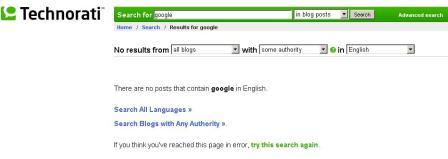
I don't wish to suggest that the blogosphere is completely unoriginal but how many posts relating to Google do you think appear every day? I'm guessing more than zero. I guess you can't make big changes without experiencing a few teething problems.
Thursday, July 27, 2006
A short video interlude
I am still deeply dissatisfied with my failure to dominate YouTube. Originally I was simply using YouTube as a tool to serve up videos for this blog but since seeing how many viewers a lot of the videos on YouTube get, I'm determined to get a bit of that action. It's that whole world domination obsession of mine.
I have learned two tricks to attracting viewers, one is featuring (or seeming to feature) semi-nekkid people and another is to respond to a popular video and ride on their coat-tails. This video is a response to one of the most popular YouTubers - a perky little 17 year old girl (so I'll obviously never be as popular as her). The context is she makes a humourous video about a science topic, this one was the coriolis effect. So here's my response:
If anyone wants to see how gross and childish I am, I'll post the first take where I farted then couldn't stop laughing. If I get enough requests, that is :)
I was also thinking of doing a "social experiment" on YouTube like my "uncut action" video where I see how many viewers I can trick into watching my videos by making them look like porn. I was going to do one with nekkid ladies, one (as requested by Saly) with nekkid men for the ladies, one with lesbians (which would attract horny hetero males, not lesbians) and one aimed at gay men. Then I would know what porn images were best for tricking desperadoes.
But I couldn't bring myself to do it. It just seemed to icky. What do you all think? Should I exploit the horny nature of YouTubers?
I have learned two tricks to attracting viewers, one is featuring (or seeming to feature) semi-nekkid people and another is to respond to a popular video and ride on their coat-tails. This video is a response to one of the most popular YouTubers - a perky little 17 year old girl (so I'll obviously never be as popular as her). The context is she makes a humourous video about a science topic, this one was the coriolis effect. So here's my response:
If anyone wants to see how gross and childish I am, I'll post the first take where I farted then couldn't stop laughing. If I get enough requests, that is :)
I was also thinking of doing a "social experiment" on YouTube like my "uncut action" video where I see how many viewers I can trick into watching my videos by making them look like porn. I was going to do one with nekkid ladies, one (as requested by Saly) with nekkid men for the ladies, one with lesbians (which would attract horny hetero males, not lesbians) and one aimed at gay men. Then I would know what porn images were best for tricking desperadoes.
But I couldn't bring myself to do it. It just seemed to icky. What do you all think? Should I exploit the horny nature of YouTubers?
Mr Angry's rules for mobile phones
I can't believe I have to post on this topic. Mobile phones are not new, people should have gotten over the "gee whiz" factor and remembered some basic rules of courtesy. Apparently not. People's current stupidity seems centred on Bluetooth (wireless) earpieces but I see plenty of examples of people being downright morons without an earpiece.
I was prompted to write this after reading an article in the Washington post titled "A tough call - invisible phone or invisible friend" which includes interviews with a couple of morons who think they are cool, switched on, cutting edge but are in fact ignorant fuck-knuckles. It's a shame the WP was beaten to the punch by a couple of months by a fairly unfunny newspaper comic who used the punchier line "hands free or off her meds?"
So for the etiquette-challenged, here are some common sense rules for using mobile phones in general and earpieces in particular.
Rule 1: Don't be a moron. This is really the only rule that is needed but clearly some people need an explanation of what behaviour qualifies them as a moron. Simply put: any person you are with, face to face, is more important than any person on the phone. You are already with a person who is physically there. You do not have to answer the phone. Wrap your head around that. You. Do. Not. Have. To. Answer. The. Phone. Which brings me to the next rule, the primary one for earpieces.
Rule 2: Only use an earpiece when you need your hands free. Driving is pretty much the only activity that I can think of that justifies this. Assuming you are not incapacitated in some way, use your fucking hands to answer your phone. The earpiece is not required to be "always on". The earpiece does not make you look cool, important or in control. When used unnecessarily, the earpiece makes you look like a fucking dork. And people hate you for using it.
Rule 3: If you're going to ignore rule 2, when wearing an earpiece, don't have it set to "auto pick up". For those who haven't inflicted one of these devices on themselves, most of them have a setting where instead of doing anything to pick up a call you can set them to "push" a call to the earpiece automatically. There's no ringing, no warning to an outsider. The wearer hears a beep in the earpiece and they start talking. Don't do this. EVER. This is amongst the rudest behaviour imaginable. The action of stopping a face to face conversation mid-sentence with no warning to start talking to someone who isn't there marks you as a fuckwit of the highest order.
So, let's pretend you're intelligent enough to follow the first three rules. When you're in public you have your phone with you and it's going to ring sometimes. You are not going to use your earpiece unless your hands are 100% unavailable. What etiquette do you follow?
Rule 4: Be polite. Defer to people around you ahead of ANY incoming calls. If you are talking to someone when your phone rings say something simple like "excuse me" and check the display to see who's calling. If there's a reason to take the call, apologise before doing so. The call is an interruption, treat it as such. Keep it short. Get over the idea that things always have to be done now. Tell the person you will call them back. Better yet, don't answer the call and let it go to voicemail. You don't have to be contactable 24 hours a day. The person on the phone has no idea why you can't answer, let them assume it's because you're doing something important. The person you're with has no doubt when you're being a rude piece of shit.
Rule 5: Some workplaces ban mobile phones. I think this is stupid but it pays to impinge as little as possible on cow-orkers. Don't have a loud, obnoxious ringtone. Ideally have your phone set to vibrate. And take your mobile with you whenever you leave your desk. Personally, I'm not going to answer a call while I'm in the toilet but I'm not going to leave my phone at my desk when I go either. There's nothing more annoying in an office than an unattended mobile that rings and rings and rings. What part of mobile don't you understand?
Rule 6: When you are having a conversation on a mobile phone in a public place be aware of the people around you. If someone else started telling strangers intimate details of your life, you'd strangle them. Why the fuck would you do so yourself? For fuck's sake, just because the people around you can't hear the person you're talking to doesn't mean they can't hear you. And trust me, nine times out of ten they don't want to know the details of your sex life. And never argue on the phone in public. I have had several experiences of people screaming and bursting into tears in public while on their mobile. It's fucking weird. Don't do it.
A corollary of this rule goes out mainly to teenage girls. Don't have squeally conversations that consist of nothing but meaningless phrases like "He didn't! No! Get out! Oh my god! Oh no she didn't! Ewwww, as if! Shut up!" I've lost count of the times I've fought down the urge to enforce the "shut up" exclamation by jamming their fucking mobile down their fucking throat. I was going to limit this rule to mobile conversations in public but it deserves wider enforcement.
Don't have conversations like that ever.
I was prompted to write this after reading an article in the Washington post titled "A tough call - invisible phone or invisible friend" which includes interviews with a couple of morons who think they are cool, switched on, cutting edge but are in fact ignorant fuck-knuckles. It's a shame the WP was beaten to the punch by a couple of months by a fairly unfunny newspaper comic who used the punchier line "hands free or off her meds?"
So for the etiquette-challenged, here are some common sense rules for using mobile phones in general and earpieces in particular.
Rule 1: Don't be a moron. This is really the only rule that is needed but clearly some people need an explanation of what behaviour qualifies them as a moron. Simply put: any person you are with, face to face, is more important than any person on the phone. You are already with a person who is physically there. You do not have to answer the phone. Wrap your head around that. You. Do. Not. Have. To. Answer. The. Phone. Which brings me to the next rule, the primary one for earpieces.
Rule 2: Only use an earpiece when you need your hands free. Driving is pretty much the only activity that I can think of that justifies this. Assuming you are not incapacitated in some way, use your fucking hands to answer your phone. The earpiece is not required to be "always on". The earpiece does not make you look cool, important or in control. When used unnecessarily, the earpiece makes you look like a fucking dork. And people hate you for using it.
Rule 3: If you're going to ignore rule 2, when wearing an earpiece, don't have it set to "auto pick up". For those who haven't inflicted one of these devices on themselves, most of them have a setting where instead of doing anything to pick up a call you can set them to "push" a call to the earpiece automatically. There's no ringing, no warning to an outsider. The wearer hears a beep in the earpiece and they start talking. Don't do this. EVER. This is amongst the rudest behaviour imaginable. The action of stopping a face to face conversation mid-sentence with no warning to start talking to someone who isn't there marks you as a fuckwit of the highest order.
So, let's pretend you're intelligent enough to follow the first three rules. When you're in public you have your phone with you and it's going to ring sometimes. You are not going to use your earpiece unless your hands are 100% unavailable. What etiquette do you follow?
Rule 4: Be polite. Defer to people around you ahead of ANY incoming calls. If you are talking to someone when your phone rings say something simple like "excuse me" and check the display to see who's calling. If there's a reason to take the call, apologise before doing so. The call is an interruption, treat it as such. Keep it short. Get over the idea that things always have to be done now. Tell the person you will call them back. Better yet, don't answer the call and let it go to voicemail. You don't have to be contactable 24 hours a day. The person on the phone has no idea why you can't answer, let them assume it's because you're doing something important. The person you're with has no doubt when you're being a rude piece of shit.
Rule 5: Some workplaces ban mobile phones. I think this is stupid but it pays to impinge as little as possible on cow-orkers. Don't have a loud, obnoxious ringtone. Ideally have your phone set to vibrate. And take your mobile with you whenever you leave your desk. Personally, I'm not going to answer a call while I'm in the toilet but I'm not going to leave my phone at my desk when I go either. There's nothing more annoying in an office than an unattended mobile that rings and rings and rings. What part of mobile don't you understand?
Rule 6: When you are having a conversation on a mobile phone in a public place be aware of the people around you. If someone else started telling strangers intimate details of your life, you'd strangle them. Why the fuck would you do so yourself? For fuck's sake, just because the people around you can't hear the person you're talking to doesn't mean they can't hear you. And trust me, nine times out of ten they don't want to know the details of your sex life. And never argue on the phone in public. I have had several experiences of people screaming and bursting into tears in public while on their mobile. It's fucking weird. Don't do it.
A corollary of this rule goes out mainly to teenage girls. Don't have squeally conversations that consist of nothing but meaningless phrases like "He didn't! No! Get out! Oh my god! Oh no she didn't! Ewwww, as if! Shut up!" I've lost count of the times I've fought down the urge to enforce the "shut up" exclamation by jamming their fucking mobile down their fucking throat. I was going to limit this rule to mobile conversations in public but it deserves wider enforcement.
Don't have conversations like that ever.
Wednesday, July 26, 2006
Mr Angry's rules for blogging
This post was inspired by one of my favourite bloggers, Rory Blyth on his blog Neopoleon (I'm sure he isn't dumb enough to twice fall for someone linking to him in the hope of being mentioned but you never know). Essentially, Rory has close to no filtering between his brain and his blog posts. He uses his real name, occasionally real photos of himself, talks about his employer (Microsoft) and frequently posts on incredibly personal topics including his relationships, his family and mental illness. He explored the topic of "rules" for blogging under the heading "Blogging is stupid" and his take is essentially the idea of rules for blogging is stupid.
On this topic I have to disagree. There are most definitely rules for blogging but they will be different for each person and situation. As far as I'm concerned the rules for blogging are the same as your rules for life. If there is something you wouldn't say or do in your real life, if you wouldn't say it to your family, if you wouldn't say it at work, if you wouldn't walk down the street shouting it at the top of your lungs, then saying it on a blog is borderline insanity.
You don't have to analyse this blog too carefully to see where I stand. I write under a pseudonym and wear a mask in my videos although it would take a determined person (or someone who knew me) five seconds to work out it was me. I generally avoid specifics unless I am writing about very public figures. I almost never post on personal issues, again, at least not on specifics. These rules are not applicable to everyone. These rules are mine and they are self imposed. In fact, I thought them all through quite carefully before I even started this blog.
The big fear in the blogosphere is getting "dooced". The term means getting fired for something you did online and is so-named in honour of Heather Armstrong who lost her job for things she posted on her blog, Dooce. Another case in the news today doesn't involve a blog but is about getting sacked for online activity involves Melanie Martinez, a presenter for a kids' show on America's PBS being sacked for a video she did a few years ago called "Technical Virgin". The video wasn't even vaguely pornographic but I find it hard to believe that a presenter for a kids' show could be so naive as to think that performing comedy related to sex wouldn't come back to haunt her. I have come to terms with the fact that I will never be a presenter on a kids' show.
I want to make it clear that I don't support sacking Dooce, Ms Martinez or pretty much anyone else for what they do online but I'm not surprised by it. The IT job market that I have to work in is small, conservative and gossipy. For this reason I'm never specific when talking about work-related issues but I do talk about work. With quite some vehemence at times. I have worked for several managers who would freak out at the idea of me blogging about the shit they go on with and doubtless will be forced to work with such losers again in the future.
To deal with this risk I made three decisions. (1) Don't be specific. (2) Be sort of anonymous. (3) Be prepared to lose a job because of my blog. I made the third decision consciously a while back. I'm no millionaire but I get paid more than I ever thought I would. My skills in the current job market just let me earn a shitload (by my estimation anyway). The thing is, I have to compete for the high paying jobs. I have decided, if worst comes to worst, to go for lower paying jobs where I'll be wildly overqualified compared to other applicants. When I say lower paid I mean still considerably more than average but less than I'm getting now.
If you're not prepared to make a similar decision stop blogging now. Even if you never blog about work. Stop blogging now. Even if you think nothing you write is offensive. Stop blogging now. Because the world is full of fuckwits. And you'll end up working for one of them. And they'll think they have the right to pass judgement on your blog. I don't think they do but then again, I'm not your employer.
That's the general points about work issues and blogging but here are some specifics. If you slander someone you deserve to pay for it. Grow a brain. If you are posting to a "company" blog and say negative/offensive/abusive things I think you're insane. That obviously makes me a wuss but I think tying your personal voice to your employer is crazy. If you're work involves getting paid by the government and you use a blog to criticise the government, well, I'm all for dissent (duh!) but I think only an idiot would be surprised by getting some blowback. A recent case involved a contractor working at the CIA getting dooced after a blog post criticising the Bush administration's policy on torture. I think Bush's pro-torture stance is an abomination against humanity but, seriously, you expect to keep a job at the CIA after saying that publicly?
A few thoughts on blogging about personal topics. Obviously I'm quite conservative in this area. I almost never mention personal things and when I do it's in the most general terms. I never use names. I think this makes me a very small minority in the blogging world and I'm fine with that. For those who focus their blogs on personal issues I say "good on you!" But I really hope you thought it through before doing so and you're not simply spouting off without considering the consequences. I've seen dozens of blogs where the writer is essentially committing relationship suicide. They say such personal things about themselves, their partners, their friends and their families while clearly having no idea if the people they're writing about find their blog they will end up absolutely hated.
Several of the names in my blogroll write about personal issues extremely well and their confidence shows they know exactly what's happening. So, writing about personal issues having thought through the potential repercussions = good. Spouting off incredibly personal details because "it's just my blog and it doesn't matter what I write" = plain fucking stupid. MySpace is basically a series of hand grenades waiting to explode and destroy thousands of lives. I suspect one day even Scoble is going to regret having provided so many details about his family through his blog.
So essentially, my number one rule for blogging is write whatever you want so long as you are prepared for the consequences. Imagine what the worst case scenario for you is. Now come to terms with the fact the worst case scenario has already come true for many, many people. Only an idiot would think it isn't going to happen to them.
On this topic I have to disagree. There are most definitely rules for blogging but they will be different for each person and situation. As far as I'm concerned the rules for blogging are the same as your rules for life. If there is something you wouldn't say or do in your real life, if you wouldn't say it to your family, if you wouldn't say it at work, if you wouldn't walk down the street shouting it at the top of your lungs, then saying it on a blog is borderline insanity.
You don't have to analyse this blog too carefully to see where I stand. I write under a pseudonym and wear a mask in my videos although it would take a determined person (or someone who knew me) five seconds to work out it was me. I generally avoid specifics unless I am writing about very public figures. I almost never post on personal issues, again, at least not on specifics. These rules are not applicable to everyone. These rules are mine and they are self imposed. In fact, I thought them all through quite carefully before I even started this blog.
The big fear in the blogosphere is getting "dooced". The term means getting fired for something you did online and is so-named in honour of Heather Armstrong who lost her job for things she posted on her blog, Dooce. Another case in the news today doesn't involve a blog but is about getting sacked for online activity involves Melanie Martinez, a presenter for a kids' show on America's PBS being sacked for a video she did a few years ago called "Technical Virgin". The video wasn't even vaguely pornographic but I find it hard to believe that a presenter for a kids' show could be so naive as to think that performing comedy related to sex wouldn't come back to haunt her. I have come to terms with the fact that I will never be a presenter on a kids' show.
I want to make it clear that I don't support sacking Dooce, Ms Martinez or pretty much anyone else for what they do online but I'm not surprised by it. The IT job market that I have to work in is small, conservative and gossipy. For this reason I'm never specific when talking about work-related issues but I do talk about work. With quite some vehemence at times. I have worked for several managers who would freak out at the idea of me blogging about the shit they go on with and doubtless will be forced to work with such losers again in the future.
To deal with this risk I made three decisions. (1) Don't be specific. (2) Be sort of anonymous. (3) Be prepared to lose a job because of my blog. I made the third decision consciously a while back. I'm no millionaire but I get paid more than I ever thought I would. My skills in the current job market just let me earn a shitload (by my estimation anyway). The thing is, I have to compete for the high paying jobs. I have decided, if worst comes to worst, to go for lower paying jobs where I'll be wildly overqualified compared to other applicants. When I say lower paid I mean still considerably more than average but less than I'm getting now.
If you're not prepared to make a similar decision stop blogging now. Even if you never blog about work. Stop blogging now. Even if you think nothing you write is offensive. Stop blogging now. Because the world is full of fuckwits. And you'll end up working for one of them. And they'll think they have the right to pass judgement on your blog. I don't think they do but then again, I'm not your employer.
That's the general points about work issues and blogging but here are some specifics. If you slander someone you deserve to pay for it. Grow a brain. If you are posting to a "company" blog and say negative/offensive/abusive things I think you're insane. That obviously makes me a wuss but I think tying your personal voice to your employer is crazy. If you're work involves getting paid by the government and you use a blog to criticise the government, well, I'm all for dissent (duh!) but I think only an idiot would be surprised by getting some blowback. A recent case involved a contractor working at the CIA getting dooced after a blog post criticising the Bush administration's policy on torture. I think Bush's pro-torture stance is an abomination against humanity but, seriously, you expect to keep a job at the CIA after saying that publicly?
A few thoughts on blogging about personal topics. Obviously I'm quite conservative in this area. I almost never mention personal things and when I do it's in the most general terms. I never use names. I think this makes me a very small minority in the blogging world and I'm fine with that. For those who focus their blogs on personal issues I say "good on you!" But I really hope you thought it through before doing so and you're not simply spouting off without considering the consequences. I've seen dozens of blogs where the writer is essentially committing relationship suicide. They say such personal things about themselves, their partners, their friends and their families while clearly having no idea if the people they're writing about find their blog they will end up absolutely hated.
Several of the names in my blogroll write about personal issues extremely well and their confidence shows they know exactly what's happening. So, writing about personal issues having thought through the potential repercussions = good. Spouting off incredibly personal details because "it's just my blog and it doesn't matter what I write" = plain fucking stupid. MySpace is basically a series of hand grenades waiting to explode and destroy thousands of lives. I suspect one day even Scoble is going to regret having provided so many details about his family through his blog.
So essentially, my number one rule for blogging is write whatever you want so long as you are prepared for the consequences. Imagine what the worst case scenario for you is. Now come to terms with the fact the worst case scenario has already come true for many, many people. Only an idiot would think it isn't going to happen to them.
Tuesday, July 25, 2006
Mr Angry's rules for contractors
This post is something I was actually asked to write. I've been asked for "career advice" a few times lately; I guess having been a contractor for ten years now does imply that I may actually know a thing or two about working successfully as a contractor. The following is what I see as some common sense guidelines both for permanent employees considering moving to contracting and contractors who want to continue contracting successfully.
The first thing to consider is what are the biggest differences between permanent and contract work? That's easy. There are two big ones: no job security and you (usually) get to say a considerably bigger number when people ask you how much you earn. There's much more to it than this but those are the big two that you're likely to be balancing when considering the leap into contracting. How much money will convince you to give up job security? For me this is a no-brainer as I don't believe there is any real job security any more, particularly in IT. Other people don't share this view and value permanent employment more highly. To state the obvious: contracting is not for the risk averse.
The dollars alone are not enough of a motivator for me and although it sounds tempting, only the most soul-less individuals can be fulfilled in their work by money alone for more than a few years. I personally like the control aspect (you never would have guessed that about me, would you?) Properly managed, the contracting lifestyle gives you considerably more control over your career and finances.
If you're going to pursue contracting for more than about a year I can't recommend strongly enough that you look into setting up your own company and contracting through this entity. It can cost a few thousand dollars to set up a company properly, depending where you live (and make it a company, NOT a trust or anything else shifty!) Get a trustworthy accountant to set things up for you. A lot of people balk at paying out the money to set up and the ongoing money to organise taxes etc but it's money well spent. This is an investment and you will get it returned multiple times over every year in tax savings if you do it properly.
Properly. Legally. It is simply not worth the risk of screwing the tax department. Bite the bullet and go legit. A good accountant will save you tens of thousands while keeping everything legal and above board.
Day to day, you're going to have to deal with three sorts of people as a contractor: employment agencies, employers and co-workers. How you relate to each of these groups is vitally important to your viability as a contractor and your emotional well-being generally.
Dealing with agencies: If you're working in a place where the IT job market isn't controlled by employment agencies count your blessings. In Sydney and Melbourne about 80% of all jobs and 95% of contract jobs are placed through agencies. You don't absolutely have to go through them but your choices are limited. Personally I think they're a waste of time. The only thing I can think of that justifies their existence is HR departments who don't want to do their jobs. If a company has an HR department they shouldn't use agencies and if a company uses agencies they should have an HR department. It's unnecessary double-handling. Or maybe I'm crazy.
So assume you have to deal with agencies. Be nice to them. Most of them are decent people (I object to the role, not the person) and you need them to get contracts. Always be professional in your dealings with agencies; this gives the good ones the confidence to represent you well and it avoids giving the bad ones an excuse to screw you. Having said that, don't let agencies dictate terms to you. Agencies should provide guidance on rates and conditions (too many of them provide no guidance at all) but they shouldn't control your life. Make sure you understand the job market so you understand what is realistic for your skill set and experience and never let yourself become dependent on a single agency.
Don't enter into an "exclusive representation" agreement with an agency unless you're on their payroll, i.e. they pay you whether or not you are working for an outside employer. Many agencies push this, they say things like it looks too unprofessional if you are going through multiple agencies looking for work. This is a complete lie. Over the years I have given my resume to dozens of agencies and never once had an employer even comment on this, let alone pass negative judgement. Any agency who pushes too heavily on this front is untrustworthy in my opinion and should be avoided. Employers go for the best applicant. Period. Agencies go for whoever will get them a commission. Period.
Dealing with employers: Rightly or wrongly, employers expect more from a contractor than from an equivalent permanent employee. It's a simple equation for them: they pay you more so they want more from you. It's important that you're absolutely clear about an employer's expectations ahead of time. You don't want any nasty surprises down the track. At the interview stage get explicit answers regarding expectations on hours to be worked, output and responsibility. Asking these questions in a way that comes across as professional rather than seeming like you're trying to get out of work is more art than science, but it's an important skill to master. If you're a contractor, you will be going to a lot of job interviews so you will get plenty of practice.
The politics of your role in the workplace can be as important (or even more important) than your output. One of the joys of being a contractor is that the learning curve for all aspects of a role are sharply accelerated. If you are permanent, often your first 3 months is taken up with "learning the ropes". Many contracts only last that long from beginning to end so you have to squeeze in learning the environment, technology, methodolgies, politics and the actual work you are delivering in the time most people take to simply get used to their new job. Again, if you can't deal with stress, contracting is not for you. The key is communication. Communicate early and often. Feed back to your employer what you understand your role to be, give regular status updates and ask for corrections if you have misunderstood anything.
Dealing with co-workers: Guess what? Permanent staff know you get paid more than them. And it pisses them off. Co-workers will fall somewhere on a spectrum between not caring at all what you are paid and being obsessed with and unreasonable about your rates despite the fact it's none of their business. You can't control how people feel about contractors, you can only control your response to them. One thing you should never do is discuss your pay rate. Seriously, nothing good can come of this. Co-workers will ask you. Come up with your own diplomatic version of "I don't like to discuss that." Anyone who presses the matter is essentially a jerk and you shouldn't feel compelled to respond to them.
If you feel compelled to respond, I recommend keeping it abstract rather than mentioning the exact amount you earn. Point out that a direct dollar comparison isn't valid because of the different nature of permanent vs contract work. The following analysis I use is reasonably accurate. It's based on Australian conditions so it won't be directly applicable to all other countries, I know some places have more annual leave and some have less. Imagine the contract rate is double the permanent rate in dollar terms (this isn't always the case, but it is sometimes and this is often the figure permanents throw at me).
Permanents get four weeks annual leave, about 10 public holidays and 5-10 paid sick days each year. If a contractor isn't at work they aren't getting paid. So if a contractor is making $100K a year and a permanent is making $50K, the permanent co-worker only has to work for 10 months to get their salary so already they've picked up 20% on the contractor. On top of that, the contractor has to handle their own taxes, insurance and superannuation which all adds up. The margin most contractors have over their permanent counterparts is much closer to 20-25% in real terms and that's simply the premium for giving up the security of permanent employment.
At the end of the day, if you are dealing with a difficult co-worker who really wants to make an issue of your pay rate, put it to them this way: if they are so sure contracting is such a great deal, why aren't they out there contracting themselves? Put up or shut up. Not that I recommend saying something that negative to a co-worker. For most people, enjoying contract work means staying on the right side of co-workers is more important than impressing employers. So try to steer conversations away from your pay rate. Whatever you do, don't be like one contract programmer I worked with who coded a little income calculator that showed in real time how much he was earning each minute he was there. And then he had it on his desktop where everyone could see it. I think they found his body face down in a ditch somewhere.
So that's my overview of rules for contractors. In subsequent posts I will be cover the rules (in my humble opinion) each of the three groups above should follow when dealing with contractors. In the meantime, I welcome any comments or questions raised by these points.
The first thing to consider is what are the biggest differences between permanent and contract work? That's easy. There are two big ones: no job security and you (usually) get to say a considerably bigger number when people ask you how much you earn. There's much more to it than this but those are the big two that you're likely to be balancing when considering the leap into contracting. How much money will convince you to give up job security? For me this is a no-brainer as I don't believe there is any real job security any more, particularly in IT. Other people don't share this view and value permanent employment more highly. To state the obvious: contracting is not for the risk averse.
The dollars alone are not enough of a motivator for me and although it sounds tempting, only the most soul-less individuals can be fulfilled in their work by money alone for more than a few years. I personally like the control aspect (you never would have guessed that about me, would you?) Properly managed, the contracting lifestyle gives you considerably more control over your career and finances.
If you're going to pursue contracting for more than about a year I can't recommend strongly enough that you look into setting up your own company and contracting through this entity. It can cost a few thousand dollars to set up a company properly, depending where you live (and make it a company, NOT a trust or anything else shifty!) Get a trustworthy accountant to set things up for you. A lot of people balk at paying out the money to set up and the ongoing money to organise taxes etc but it's money well spent. This is an investment and you will get it returned multiple times over every year in tax savings if you do it properly.
Properly. Legally. It is simply not worth the risk of screwing the tax department. Bite the bullet and go legit. A good accountant will save you tens of thousands while keeping everything legal and above board.
Day to day, you're going to have to deal with three sorts of people as a contractor: employment agencies, employers and co-workers. How you relate to each of these groups is vitally important to your viability as a contractor and your emotional well-being generally.
Dealing with agencies: If you're working in a place where the IT job market isn't controlled by employment agencies count your blessings. In Sydney and Melbourne about 80% of all jobs and 95% of contract jobs are placed through agencies. You don't absolutely have to go through them but your choices are limited. Personally I think they're a waste of time. The only thing I can think of that justifies their existence is HR departments who don't want to do their jobs. If a company has an HR department they shouldn't use agencies and if a company uses agencies they should have an HR department. It's unnecessary double-handling. Or maybe I'm crazy.
So assume you have to deal with agencies. Be nice to them. Most of them are decent people (I object to the role, not the person) and you need them to get contracts. Always be professional in your dealings with agencies; this gives the good ones the confidence to represent you well and it avoids giving the bad ones an excuse to screw you. Having said that, don't let agencies dictate terms to you. Agencies should provide guidance on rates and conditions (too many of them provide no guidance at all) but they shouldn't control your life. Make sure you understand the job market so you understand what is realistic for your skill set and experience and never let yourself become dependent on a single agency.
Don't enter into an "exclusive representation" agreement with an agency unless you're on their payroll, i.e. they pay you whether or not you are working for an outside employer. Many agencies push this, they say things like it looks too unprofessional if you are going through multiple agencies looking for work. This is a complete lie. Over the years I have given my resume to dozens of agencies and never once had an employer even comment on this, let alone pass negative judgement. Any agency who pushes too heavily on this front is untrustworthy in my opinion and should be avoided. Employers go for the best applicant. Period. Agencies go for whoever will get them a commission. Period.
Dealing with employers: Rightly or wrongly, employers expect more from a contractor than from an equivalent permanent employee. It's a simple equation for them: they pay you more so they want more from you. It's important that you're absolutely clear about an employer's expectations ahead of time. You don't want any nasty surprises down the track. At the interview stage get explicit answers regarding expectations on hours to be worked, output and responsibility. Asking these questions in a way that comes across as professional rather than seeming like you're trying to get out of work is more art than science, but it's an important skill to master. If you're a contractor, you will be going to a lot of job interviews so you will get plenty of practice.
The politics of your role in the workplace can be as important (or even more important) than your output. One of the joys of being a contractor is that the learning curve for all aspects of a role are sharply accelerated. If you are permanent, often your first 3 months is taken up with "learning the ropes". Many contracts only last that long from beginning to end so you have to squeeze in learning the environment, technology, methodolgies, politics and the actual work you are delivering in the time most people take to simply get used to their new job. Again, if you can't deal with stress, contracting is not for you. The key is communication. Communicate early and often. Feed back to your employer what you understand your role to be, give regular status updates and ask for corrections if you have misunderstood anything.
Dealing with co-workers: Guess what? Permanent staff know you get paid more than them. And it pisses them off. Co-workers will fall somewhere on a spectrum between not caring at all what you are paid and being obsessed with and unreasonable about your rates despite the fact it's none of their business. You can't control how people feel about contractors, you can only control your response to them. One thing you should never do is discuss your pay rate. Seriously, nothing good can come of this. Co-workers will ask you. Come up with your own diplomatic version of "I don't like to discuss that." Anyone who presses the matter is essentially a jerk and you shouldn't feel compelled to respond to them.
If you feel compelled to respond, I recommend keeping it abstract rather than mentioning the exact amount you earn. Point out that a direct dollar comparison isn't valid because of the different nature of permanent vs contract work. The following analysis I use is reasonably accurate. It's based on Australian conditions so it won't be directly applicable to all other countries, I know some places have more annual leave and some have less. Imagine the contract rate is double the permanent rate in dollar terms (this isn't always the case, but it is sometimes and this is often the figure permanents throw at me).
Permanents get four weeks annual leave, about 10 public holidays and 5-10 paid sick days each year. If a contractor isn't at work they aren't getting paid. So if a contractor is making $100K a year and a permanent is making $50K, the permanent co-worker only has to work for 10 months to get their salary so already they've picked up 20% on the contractor. On top of that, the contractor has to handle their own taxes, insurance and superannuation which all adds up. The margin most contractors have over their permanent counterparts is much closer to 20-25% in real terms and that's simply the premium for giving up the security of permanent employment.
At the end of the day, if you are dealing with a difficult co-worker who really wants to make an issue of your pay rate, put it to them this way: if they are so sure contracting is such a great deal, why aren't they out there contracting themselves? Put up or shut up. Not that I recommend saying something that negative to a co-worker. For most people, enjoying contract work means staying on the right side of co-workers is more important than impressing employers. So try to steer conversations away from your pay rate. Whatever you do, don't be like one contract programmer I worked with who coded a little income calculator that showed in real time how much he was earning each minute he was there. And then he had it on his desktop where everyone could see it. I think they found his body face down in a ditch somewhere.
So that's my overview of rules for contractors. In subsequent posts I will be cover the rules (in my humble opinion) each of the three groups above should follow when dealing with contractors. In the meantime, I welcome any comments or questions raised by these points.
Monday, July 24, 2006
Mr Angry runs your life for you
I was planning some future posts for this blog and a long-established pattern suddenly became clear to me. The vast majority of material I have been writing revolves around rules. Rules for life. Rules for work. Even rules for romance. I realised this was for a good reason: people are sheep who need to be led.
Let me provide a bit of clarification: I have decided people fall into one of three categories. (1) Idiots who will never get it together and need to be beaten with sticks/fucked in the neck with various implements/regularly castigated in this blog. (2) People looking for guidance who will follow my god-like decrees without question, I mean, people who will take my thoughtful, gently articulated advice on board and change their lives accordingly. (3) People who completely get it and are part of the angry alliance. See my blogroll and regular commenters for examples of these people. Get to know them because they will be forming the government, secret police and my personal bodyguard when I take over the world.
It seems, without realising it, I have been forming my manifesto through these blog posts. It just goes to show, if you don't know for sure what you want to do with a blog make sure you say what needs to be said first and the big picture will come into focus later. So don't be troubled if you feel a compulsion to change your previously existing world view to conform with mine.
It's for your own good.
Let me provide a bit of clarification: I have decided people fall into one of three categories. (1) Idiots who will never get it together and need to be beaten with sticks/fucked in the neck with various implements/regularly castigated in this blog. (2) People looking for guidance who will follow my god-like decrees without question, I mean, people who will take my thoughtful, gently articulated advice on board and change their lives accordingly. (3) People who completely get it and are part of the angry alliance. See my blogroll and regular commenters for examples of these people. Get to know them because they will be forming the government, secret police and my personal bodyguard when I take over the world.
It seems, without realising it, I have been forming my manifesto through these blog posts. It just goes to show, if you don't know for sure what you want to do with a blog make sure you say what needs to be said first and the big picture will come into focus later. So don't be troubled if you feel a compulsion to change your previously existing world view to conform with mine.
It's for your own good.
Subscribe to:
Posts (Atom)